


Views: 0 Author: Site Editor Publish Time: 2026-10-30 Origin: Site


D2C and retail brands face a diminishing return on standard packaging formats. Structural differentiation is now a primary driver of perceived product value. Shoppers expect unique tactile experiences. Standard boxes often fail to deliver this visual disruption.
The decision between standard rectangular cartons and alternative geometries is no longer just aesthetic. It directly impacts warehousing space, fulfillment velocity, and freight costs. Brands must balance beautiful design against cold logistical realities. A poor choice here will erode your profit margins.
Choosing between a Cylinder box and traditional packaging requires looking past the unboxing experience. You must evaluate volumetric weight penalties, storage realities, and structural crush resistance. This analysis ensures your final decision protects both your product and your bottom line.
Protection vs. Space: Cylinder boxes offer superior vertical crush resistance but require more dead space in master shipping cartons compared to flat-packed traditional boxes.
Logistics Impact: Traditional packaging scales more efficiently for high-volume, automated fulfillment due to flat storage and standard palletization.
Premium Positioning: Cylinder box packaging commands a higher perceived value, particularly in cosmetics, spirits, and premium apparel, justifying higher unit costs.
Sizing Reality: A large cylinder box effectively protects rolled or uniquely shaped goods (like posters or bottles) but incurs dimensional weight (DIM) pricing penalties during shipping.
Defining your operational baselines is critical. You must map out these constraints before committing to a tooling and production run. Many brands rush into custom die-lines. They fail to assess how new geometries disrupt their current supply chain. You need a clear understanding of both standard and alternative formats.
Traditional packaging relies on flat-packing mechanisms. Folding cartons and corrugated mailers arrive at your facility completely flat. Manufacturers use straight-line gluing to assemble them. This method enables standardized pallet optimization. You can fit thousands of unconstructed units onto a single pallet. Flat storage drastically reduces inbound freight costs. It also keeps warehouse storage fees low.
Alternative shapes require different manufacturing techniques. Pre-assembled rigid structures define most tube packaging. Suppliers build them using spiral-wound or convolute paper tubes. Common closures include cap-and-base or telescopic designs. These items arrive at your warehouse fully constructed. Cylinder Box packaging features curved printable surface areas. This curved real estate offers unique branding opportunities. However, the pre-assembled nature demands significantly more storage space.
You must align your packaging type with specific business metrics. Product margins dictate how much you can spend on custom shapes. Fulfillment center capabilities determine whether you can handle manual assembly. Retail shelf-space requirements influence your outer dimensions. Establish these success criteria early.
Feature | Traditional Cartons | Cylinder Boxes |
|---|---|---|
Arrival State | Flat-packed | Pre-assembled |
Pallet Density | Extremely High | Low to Moderate |
Fulfillment Process | Automated or fast manual | Primarily manual |
Shelf Disruption | Standard / Low | High / Premium |
Packaging must protect your product during transit. Material strength matters. Geometry plays an equally crucial role. Different shapes handle external stress in very different ways.
The continuous geometry of a tube distributes external pressure evenly. This physics principle makes circular structures highly resistant to crushing. They resist collapsing much better than standard folding cartons. Traditional boxes have sharp corners. These corners act as weak points under heavy top-load pressure. A continuous curved wall eliminates these vulnerable edges. This provides excellent vertical crush resistance.
Not every product belongs in a tube. You must evaluate the physical properties of your SKU. Consider the following alignments:
Optimal fits for cylinders: Liquids, granular products, apparel (rolled), and fragile vertical items.
Suboptimal fits: Square or multi-component items. These create excessive internal "dead space." You will need custom inserts to prevent rattling.
Common mistake: Placing a square bottle inside a round tube without an insert. The product will shift during transit. This increases the risk of damage. Always design custom internal fitments for non-round items.
Evaluating structural limits is crucial when scaling up dimensions. A Large cylinder box excels at preventing creases in rolled goods. It also protects heavy glass bottles effectively. Large diameters introduce new challenges, though. They require thicker walls to maintain rigidity. You must specify a higher paper GSM (grams per square meter). Thinner walls on wide tubes will dent easily upon impact. Always request crush-test data from your supplier for oversized formats.
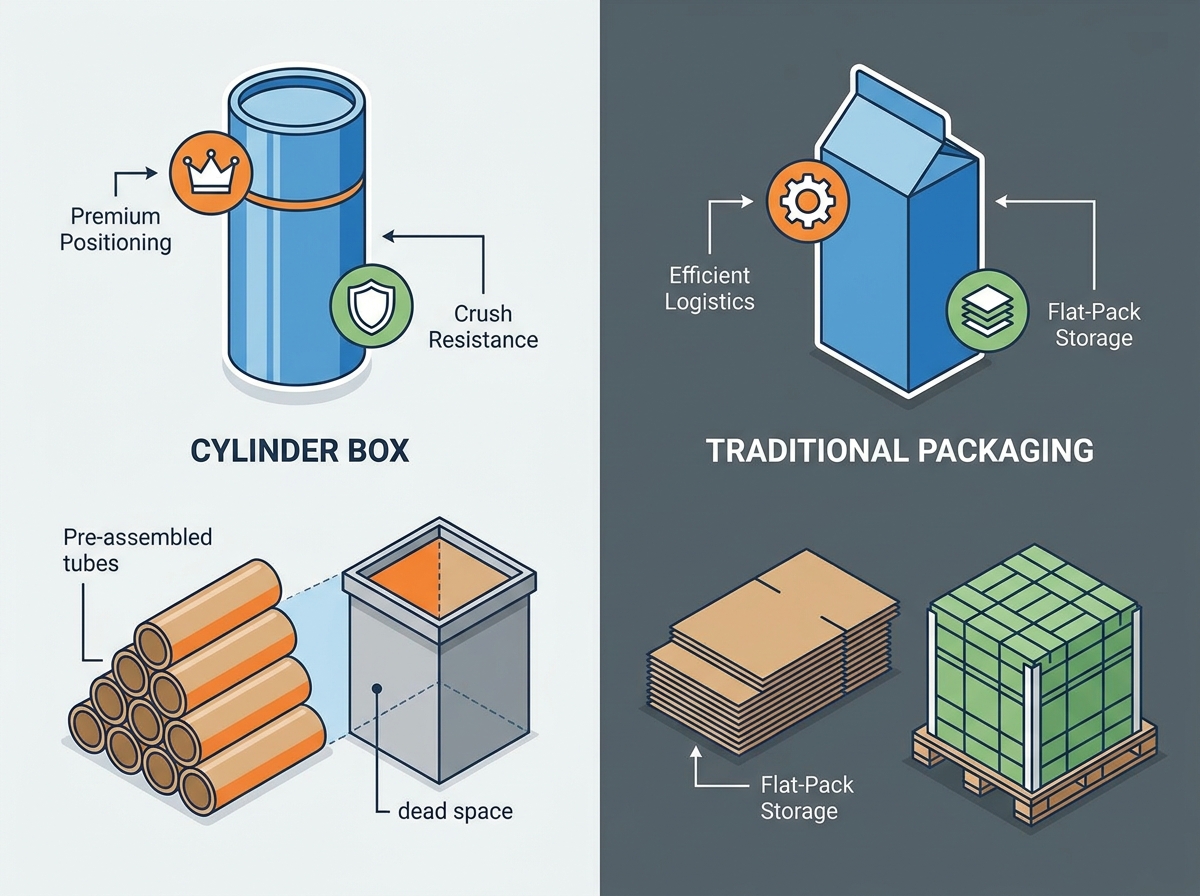
Design teams often ignore supply chain realities. Moving products efficiently dictates long-term profitability. You must uncover the hidden costs of deviating from standard rectangular configurations.
Traditional folding cartons store flat. They maximize warehouse space effortlessly. A single shelf can hold thousands of unassembled cartons. Tube structures present the opposite scenario. They are shipped and stored pre-assembled. This drastically increases your required storage footprint. You are essentially paying to store empty air. If your 3PL charges per pallet position, your warehousing costs will spike immediately.
Shipping carriers charge based on dimensional weight. They calculate volume rather than just actual weight. Packing circular objects into rectangular master cartons creates roughly 20% void space. This leads to shipping "air." You face higher freight costs per unit. A standard Cylinder box requires a larger outer master carton than a tightly packed square box. You must factor these DIM penalties into your final product pricing.
Speed inside the warehouse directly impacts labor costs. Traditional boxes are compatible with automated box-erecting machines. These machines can fold, tape, and output dozens of boxes per minute. Tube packaging typically requires manual fulfillment. Workers must physically remove the lid, insert the item, and secure the closure. This caps scalability. It becomes cost-prohibitive for low-margin, high-volume products.
Request a detailed pallet layout from your manufacturer before ordering.
Calculate the DIM weight of your master shipper using your carrier's current divisor.
Conduct a time-study on manual packing speeds to project labor costs accurately.
Visual merchandising drives retail success. The unboxing moment drives D2C loyalty. Packaging shape influences consumer psychology deeply.
Cylindrical shapes break visual monotony on retail shelves. Most aisles feature endless rows of square boxes. A curved silhouette captures consumer attention instantly. It suggests a premium, artisanal, or highly durable product. Brands in the cosmetics, spirits, and luxury tea markets leverage this shape. They use it to justify premium price points. The tactile experience of opening a telescoping tube feels deliberate and luxurious.
Designing for curves requires specialized skill. Traditional boxes offer distinct, flat panels. These panels provide perfect canvases for clear typography. They make barcode scanning simple. Tube designs operate differently. They require continuous wraparound artwork.
Brands must account for graphic distortion. Elements placed on the extreme left or right of the facing curve will warp. You must also ensure mandatory compliance labels remain scannable. A barcode printed horizontally across a tight curve may fail at the register. Always print barcodes vertically on curved surfaces.
Round items pose handling challenges. Rolling hazards exist on retail shelves and during transit. Unsecured tubes can roll off displays, causing product damage. Often, you must incorporate secondary solutions. This might include flat-bottomed internal inserts. Alternatively, you may need secondary outer cartons. These additions stabilize the product but increase your overall packaging spend.
Brand vision must eventually align with budget constraints and environmental regulations. Specialized shapes carry specialized financial and ecological considerations.
Custom shapes require custom tools. Tooling and Minimum Order Quantities (MOQs) for tubes are generally higher than standard corrugated options. Factories use specialized manufacturing equipment to wind and glue the paper cores. Setup times are longer. You should expect longer lead times and higher upfront capital requirements when launching a new structural design.
Consumers demand eco-friendly solutions. Both options can be highly sustainable if engineered correctly. Using FSC-certified kraft paper is a strong baseline for either format.
You must exercise caution regarding material composition. Avoid mixed-material cylinders. Many older designs feature paper tubes with glued metal bases or plastic end-caps. These mixed structures frustrate end-consumer recycling. Sorting facilities cannot separate the metal from the paper easily. Consequently, these items end up in landfills.
Standard mono-material folding cartons often have higher recycling compliance rates. If you choose a Cylinder Box packaging solution, insist on a 100% paperboard construction. Rolled paper edges function perfectly well without requiring metal or plastic reinforcements.
Making the final choice requires a structured approach. Review your operational constraints, margin targets, and brand positioning.
You require flat-pack storage due to severe warehouse space constraints.
Your product has a low profit margin. You need highly automated fulfillment to remain profitable.
Minimizing dimensional shipping weight is your primary Key Performance Indicator (KPI).
Your retail partners mandate easily stackable, rectangular footprints for shelving efficiency.
Your product benefits visually or physically from a tube shape. Skincare serums, craft spirits, and specialty teas are excellent examples.
You are launching a high-margin, premium SKU. The unboxing experience heavily dictates the perceived brand value.
You require maximum vertical crush resistance. You want to achieve this without relying on heavy internal void-fill.
You want to break the visual monotony of crowded retail shelves.
Move from theory to practical testing. Request unprinted structural samples from your supplier. These are known as white comps. Use them to test fulfillment times on your packing line. Measure the exact master carton fit. Finally, run a mock shipping label to calculate final DIM weight costs with your 3PL. Data-driven testing prevents costly roll-out mistakes.
Traditional packaging remains the undisputed leader for operational efficiency. It maximizes warehouse density and keeps freight costs low. However, alternative shapes act as a strategic lever. They offer premium brand positioning and specialized structural protection.
Base your final decision on a holistic analysis, not just aesthetic preference. You must calculate freight volume changes, storage footprint expansion, and manual packing labor. Let data guide your strategy.
Evaluate your profit margins before selecting pre-assembled structures.
Run physical time-studies on your fulfillment lines to gauge labor impacts.
Always specify mono-material construction to ensure true recyclability.
Test structural white comps for transit durability before approving final artwork.
A: Yes, typically 15–30% more per unit due to pre-assembly, higher shipping volume, and specialized tooling.
A: It is possible if the wall thickness is sufficient and caps are sealed securely, but carrier sorting machines can occasionally damage unprotected cylindrical packages. Secondary rectangular mailers are recommended.
A: Only if they are mono-material (100% paperboard). Tubes with glued metal bases or plastic lids require separation, often leading to them being landfilled.


