


Views: 0 Author: Site Editor Publish Time: 2026-10-16 Origin: Site


Procuring industrial enclosures and packaging goes far beyond mere aesthetics. It mitigates severe operational risks across your entire facility. It ensures strict environmental compliance while preventing catastrophic asset damage. Specifying the incorrect container causes major issues down the line. Choosing the wrong unit for hazardous gas storage creates real danger. An error in explosion-proof instrumentation or end-of-line logistics triggers heavy regulatory fines. It directly compromises overall site safety. It also introduces massive supply chain bottlenecks into your daily operations. This comprehensive guide bypasses typical manufacturer marketing claims. We break down the five most critical industrial applications for these enclosures. You will explore verifiable testing standards alongside practical implementation risks. Procurement and engineering teams will gain a completely transparent evaluation framework. You can finally make specifications based on empirical evidence rather than assumptions.
Compliance dictates material: The application environment (e.g., corrosive, high-pressure, combustible) must dictate the specific gauge and certification (NEMA, ATEX, OSHA) of the cylinder box.
Scale impacts specification: Large cylinder box requirements for transit vastly differ from compact explosion-proof enclosures in terms of structural reinforcement and mounting logic.
Hidden costs in packaging: Subpar cylinder box packaging increases failure rates during transit; evaluating crush resistance and dimensional weight optimization is critical for ROI.
Vendor evaluation: Shortlist suppliers based on verifiable testing data, custom fabrication capabilities, and historical compliance track records, not just unit cost.
Industrial facilities require heavily reinforced enclosures. They store volatile, high-pressure industrial gases safely. These zones sit away from active manufacturing lines. Your success criteria focus on zero leakage accumulation. Strict compliance aligns entirely against NFPA and OSHA storage regulations. Successful containment matters deeply during any localized valve failure. We evaluate these structures across specific dimensions.
Ventilation architecture forms a primary consideration. Passive exhaust systems differ vastly from active exhaust setups. You must prevent hazardous gas pooling internally. Access and security also require careful evaluation. Tamper-proof locking mechanisms keep unauthorized personnel out. Emergency-access breakaway points allow quick responder entry during crises.
You must understand the common gases requiring strict isolation:
Silane (Highly pyrophoric, requires active purging)
Chlorine (Severely corrosive, demands specific material grades)
Hydrogen (Extreme flammability, needs superior top-venting)
Anhydrous Ammonia (Toxic inhalation hazard, requires strict seal integrity)
Implementation risks exist at the planning stage. Planners often fail to account for facility footprint constraints. You might place a Large cylinder box in a highly restricted area. Forklifts need sufficient clearance. Maneuverability during cylinder swaps is critical. You cannot sacrifice operational pathways for storage space. Always measure turning radiuses before installation.
Engineers deploy compact, heavy-walled metallic containers in volatile atmospheres. They house electrical junctions, sensitive sensors, and critical instrumentation. We typically see these in Class I, Division 1 or 2 environments. Your main success criterion remains complete isolation. You must prevent internal sparks from reaching the external combustible atmosphere. An internal explosion cannot breach the outer wall.
We evaluate thread integrity heavily. Precision-machined threaded covers cool escaping gases efficiently. They lower gas temperatures well below external ignition thresholds. Material selection requires a delicate engineering balance. Copper-free aluminum provides excellent lightweight properties. Meanwhile, 316L stainless steel offers superior corrosion resistance.
Enclosure Material Comparison Table
Material Type | Weight Profile | Corrosion Resistance | Thermal Conductivity |
|---|---|---|---|
Copper-Free Aluminum | Lightweight | Moderate (Requires coating) | High |
316L Stainless Steel | Heavy | Excellent (Harsh washdowns) | Low |
Reinforced Fiberglass | Very Lightweight | High (Chemical resistant) | Very Low |
Implementation risks carry severe liability. Improper installation happens frequently in the field. Cross-threading damages the precise machining. Technicians sometimes forget approved sealing fittings. This immediately voids the explosion-proof rating. It leaves your facility entirely exposed. You must ensure rigorous training for installation teams. A basic error creates catastrophic potential.
Manufacturers use specialized Cylinder Box packaging at the end of production lines. They protect high-value manufactured cylindrical components. These include precision rollers, machined pipes, or extruded materials. These items travel through global transit networks. Success means zero dimensional distortion upon delivery. Customers demand zero surface marring. You also want optimal pallet space utilization.
We evaluate crush resistance closely. Verifiable burst strength must match the enclosed industrial component weight. You must compare Edge Crush Test (ECT) metrics against Box Compression Test (BCT) standards. Internal dunnage plays an equally vital role. Custom-molded inserts suspend the heavy part safely. They prevent damaging friction and dangerous shock loads.
Common dunnage materials include:
High-density polyethylene (HDPE) foam blocks
Custom molded pulp saddles
Corrugated structural bulkheads
Vibration-dampening rubber mounts
Implementation risks often stem from over-engineering. Some engineers design excessively thick walls. This bloats your freight costs rapidly. Excessive dimensional weight ruins shipping budgets. Failing to test packaging under realistic conditions poses another threat. High-humidity transit environments degrade structural integrity. You must run environmental simulation tests first.
Technicians need robust protection for delicate instruments. They use mobile or semi-permanent cylindrical enclosures. These units protect vital diagnostic tools. They shield gauges and calibration weights from harsh plant conditions. Success requires a strictly maintained internal environmental baseline. You must control temperature, humidity, and dust exclusion. This prevents expensive tool degradation over time.
We look at Ingress Protection ratings first. IP66 or IP67 ratings provide verifiable dust-tight performance. They also guarantee water-resistant characteristics. You can confidently deploy a Cylinder box in washdown areas. Shock absorption dictates internal design choices. Internal foam density matters during sudden drops. Proper vibration dampening characteristics extend equipment life significantly.
Implementation risks involve hardware durability. Engineers sometimes specify enclosures featuring inadequate latching mechanisms. These latches degrade after repeated daily use. Field technicians open them constantly. A broken latch compromises the environmental seal entirely. Always specify heavy-duty, field-replaceable latching hardware. Avoid cheap plastic components on external hinges.
Moving bulk cylindrical items requires specific logistics hardware. Facilities deploy a Large cylinder box or modular crate system. These systems move inventory across plant floors securely. They also facilitate transport between different facilities. You want maximized load density. However, you cannot compromise structural integrity. Worker safety remains paramount during loading and unloading.
We evaluate stackability as a primary metric. Load-bearing designs allow secure vertical stacking. They do not stress the lower units. Handling integration determines daily operational speed. Pre-engineered forklift pockets save massive time. Crane lifting eyes and pallet jack clearances ensure universal handling. Your logistics team needs versatile lifting options.
Implementation risks often involve weight miscalculations. Teams sometimes ignore the tare weight of robust enclosures. This oversight pushes gross payload weights dangerously high. You might exceed the legal limits of localized transport infrastructure. Standard material handling equipment might fail under the strain. Calculate full gross weights meticulously before deployment. Train forklift operators regarding new load centers.
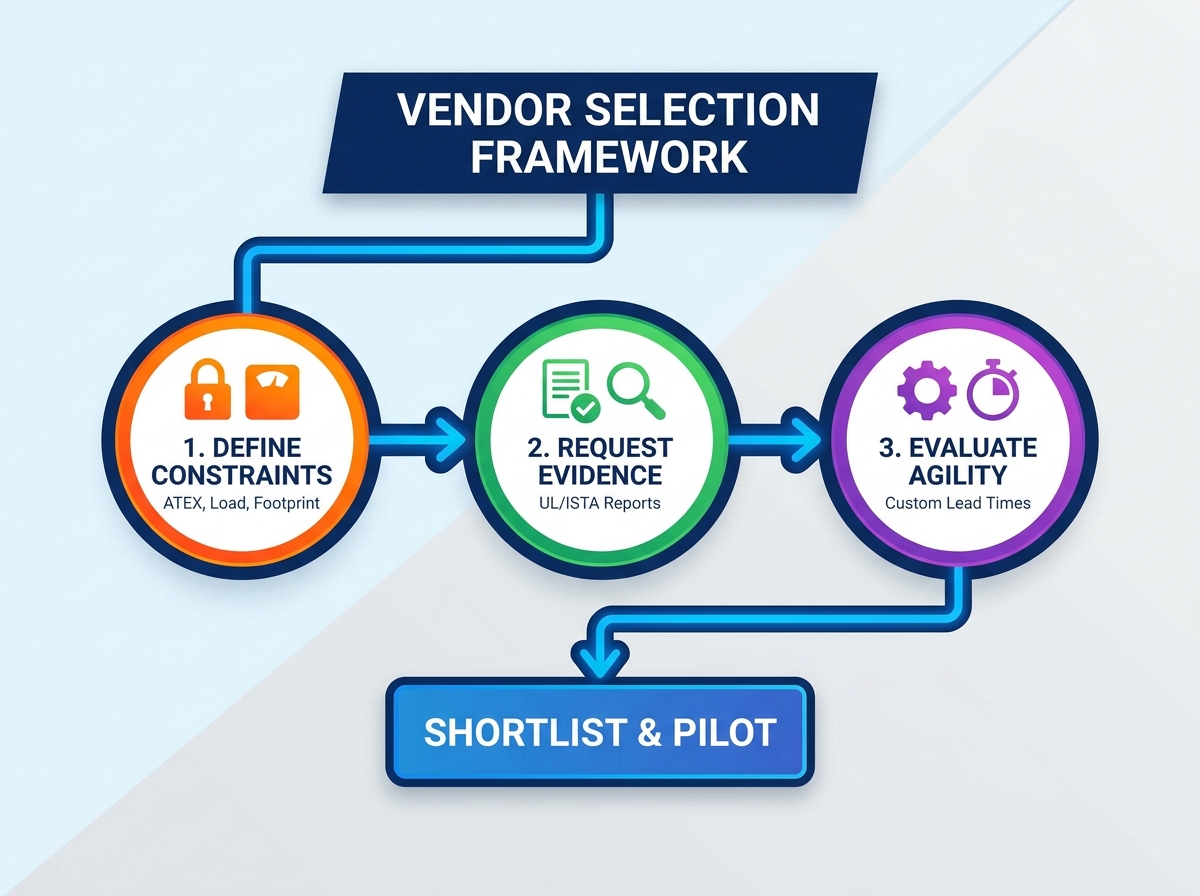
Procurement teams face a massive challenge. Narrowing down suppliers feels overwhelming. Standard specification sheets often look identical on the surface. You need a reliable decision framework. First, you define the absolute constraints. You might require ATEX Directive compliance. You might need a unit holding exactly 500 lbs. The enclosure might need to fit through a standard 36-inch doorway.
Second, you must request empirical evidence. Demand third-party testing certificates immediately. UL listings and ISTA transit testing reports prove actual performance. Do not accept self-certified marketing claims blindly. Third, evaluate customization agility closely. Assess the vendor lead times carefully. They might need to modify a standard Cylinder box for you. This involves adding custom knockouts or specific mounting brackets.
Vendor Evaluation Scoring Chart
Evaluation Criteria | Low Score Indicator | High Score Indicator |
|---|---|---|
Empirical Evidence | In-house testing only | Third-party UL/ISTA certificates |
Customization Agility | 12+ weeks lead time | 4-6 weeks for modified standards |
Engineering Support | Sales reps only | Direct access to application engineers |
Material Traceability | No origin certificates | Full mill test reports available |
Next-step actions require strict discipline. Move away from generalized catalog browsing. Draft a rigorous technical requirements document instead. Request a prototype or a pilot unit. Conduct rigorous on-site evaluation before committing. A volume purchase requires absolute certainty.
Selecting the right enclosure requires strict calculation. You balance regulatory compliance alongside physical durability. You also factor in overall operational efficiency. Every facility presents unique environmental challenges. Your specification process must reflect these realities.
Do not compromise on structural or testing requirements. Saving marginal upfront costs creates massive risk. The downstream expenses of product damage heavily outweigh initial savings. Safety incidents destroy operational budgets. Compliance failures trigger severe legal consequences. Always prioritize verifiable engineering data over marketing claims.
Engage directly with application engineers today. Review your specific environmental constraints together. Request targeted CAD models to verify footprint compatibility. Ask for material samples to test local corrosion resistance. A proactive procurement strategy prevents catastrophic field failures entirely.
A: Compare the upfront cost of powder-coated carbon steel against premium alternatives. Powder-coated steel is cheaper initially but rusts upon scratching. 304 or 316 stainless steel provides long-term corrosion resistance. Reinforced fiberglass offers a zero-maintenance lifespan. Your specific environmental corrosivity dictates the true ROI.
A: Packaging impacts your carrier dimensional weight (DIM weight) pricing models. Bulky exterior dimensions trigger higher DIM weight penalties. Reducing internal void space lowers the overall package size. Optimized packaging protects the asset while keeping dimensional volume under costly freight thresholds.
A: No. Aftermarket modifications typically void existing explosion-proof or NEMA certifications. Drilling unapproved holes or adding welds compromises the precise flame paths. Any hazardous location customizations must be strictly engineered and certified directly by the original manufacturer.


