


Views: 0 Author: Site Editor Publish Time: 2026-10-16 Origin: Site


Transitioning solid cosmetics from plastic to paper packaging introduces major structural variables. These operational shifts directly impact product viability on the retail shelf. Consumer demand heavily drives this rapid shift toward sustainable packaging today. However, brands must rigorously evaluate physical constraints before moving to mass production. Issues like oil resistance, push-up mechanics, and overall shelf-stability require careful testing. A sudden packaging switch without formulation validation often leads to costly manufacturing failures.
This article offers an objective evaluation of these eco-friendly containers as a viable commercial packaging solution. We will cover dimensional accuracy, capacity matching, and critical filling limitations. You will also learn how to verify sustainability claims accurately to avoid greenwashing. By understanding these mechanical and chemical boundaries, you can successfully implement sustainable packaging without compromising the end-user experience.
Understanding the mechanical differences between traditional plastic containers and paper alternatives remains crucial for a successful product launch. A standard plastic twist-up uses an internal threaded spindle. Consumers turn a bottom dial, and the spindle drives a plastic carriage upward. This mechanism locks the product in place. You can also retract the product easily by twisting the dial in the opposite direction.
Conversely, a push up paper tube operates on a fundamentally simpler blueprint. It relies on a free-floating bottom disc made of paperboard. Consumers apply direct manual upward pressure to the base to expose the product. This mechanism entirely eliminates internal gears, dials, and plastic spindles.
This minimalist design creates a delicate engineering balance based on friction. Manufacturers must calibrate the internal tolerance perfectly. If the fit is too tight, the consumer simply cannot push the product upward. If the fit is too loose, the free-floating disc fails to hold the formula's weight. A loose disc causes the product to drop back down during use or leak from the bottom during transit.
Eliminating plastic spindles yields significant ecological benefits. It drastically reduces the overall component count and simplifies the supply chain. However, you must frame this component reduction as a potential user-experience friction point. Consumers cannot easily retract pushed-up product. They must gently tap the base on a hard surface to slide the product back down. Brands must communicate this usage difference clearly on their packaging to manage consumer expectations.
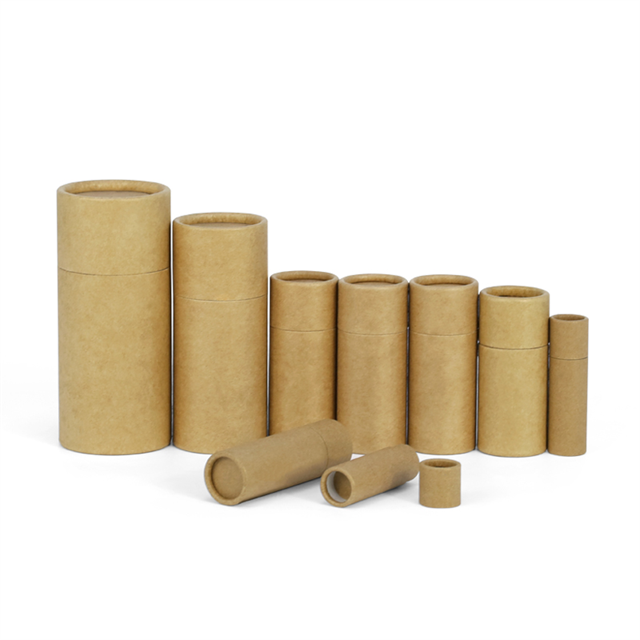
Mapping external dimensions to internal volume requires precise calculations. Plastic components use very thin walls. Paperboard requires substantial thickness to maintain structural integrity under pressure. Heavy-duty kraft paper walls often measure between 1.5mm and 2mm thick. This thickness means external dimensions appear much larger than an equivalent plastic volume.
You cannot determine capacity merely by measuring the outside of the tube. You must calculate the actual fillable volume. Start by measuring the total internal height. Subtract the space occupied by the bottom push disc. Then, subtract the required top clearance needed for capping. The remaining internal cavity dictates your true fill weight.
Standard Volume to Dimension Mapping Table
| Size Category | Volume Range | Common Product Applications |
|---|---|---|
| Small | 0.3 oz / 10g | Lip balms, solid perfumes, localized spot treatments. |
| Medium | 1 oz to 1.25 oz / 30-35g | Solid serums, travel-size deodorants, lotion bars. |
| Large | 2 oz to 2.5 oz / 60-70g+ | Standard deodorants, body balms, and sunscreen sticks. |
Formulators often encounter sizing surprises during their first trial runs. A 1 oz paper tube feels bulkier in hand than a 1 oz plastic stick. Brands must account for this discrepancy during secondary packaging design. Your folding cartons or shipping mailers must accommodate these wider diameters. We recommend ordering physical samples across multiple capacities before finalizing your formulation weight.
Furthermore, base loss remains a critical factor. The free-floating disc requires a specific thickness to resist bending when the user pushes it. This thick disc consumes valuable internal real estate. If you ignore this base loss, you will consistently underfill your products. Always perform a water-weight test on empty samples to verify the exact internal capacity.
Solid cosmetics contain high concentrations of waxes, oils, and butters. Raw paperboard readily absorbs these lipids. Without proper protection, formulas will seep through the walls. This causes exterior staining, label peeling, and rapid structural degradation. You must specify appropriate barrier linings to prevent this chemical migration.
Barrier Lining Comparison Chart
| Lining Material | Barrier Performance | Sustainability Profile |
|---|---|---|
| Plant-Based Wax | Moderate. Best for low-moisture balms. | Excellent. Fully compostable and repulpable. |
| PLA (Polylactic Acid) | High. Excellent oil and water resistance. | Good. Requires industrial composting facilities. |
| PE (Polyethylene) | Very High. Total moisture block. | Poor. Creates microplastics and hinders recycling. |
We do not recommend PE linings if your brand intends to make verifiable eco-claims. PE creates a mixed-material product. Most recycling facilities cannot separate the plastic film from the paperboard. A truly recyclable push-up paper tube relies on plant-based waxes or advanced water-based dispersion coatings.
Beyond material selection, thermal constraints dictate your entire manufacturing process. Formulators must establish strict temperature thresholds for hot-pouring. Most standard paperboard adhesives fail when exposed to excessive heat. You typically must keep pouring temperatures under 140°F (60°C). Pouring too hot introduces severe failure risks.
If the formulation temperature exceeds the adhesive's melting point, the bottom seam will separate. The free-floating disc may warp or sink. Extreme heat also compromises the internal liner. The wax coating melts, allowing hot oils to migrate into the raw kraft paper before the product solidifies. You must carefully calibrate your cooling tunnels and pouring nozzles to match these thermal limits.
Sustainable packaging marketing often falls victim to greenwashing. Brands must look beyond the brown kraft exterior to validate end-of-life realities. Your procurement team must establish strict sourcing standards. Always require FSC-certified (Forest Stewardship Council) paperboards as a baseline. This certification guarantees your material originates from responsibly managed forests rather than protected ecosystems.
You must deconstruct what makes the tube verifiable for curbside recycling or industrial composting. The core metric is repulpability. Standard recycling facilities use water and agitation to break down paper into pulp. If the barrier lining prevents the water from breaking down the fibers, the facility sends the tube to a landfill. Plant-based wax linings typically pass repulpability tests, while heavy PLA or PE linings fail.
You should provide suppliers with a strict framework of questions. Ask them specifically about adhesive toxicity. Many cheap industrial adhesives contain volatile organic compounds (VOCs) or synthetic polymers. These chemicals contaminate compost soil. Request data on the biodegradability timeline of all inner coatings. A supplier should confidently provide this documentation.
Do not accept vague environmental claims. Mention the necessity of requesting ASTM D6868 test reports. This standard evaluates the compostability of plastics and coatings used on paper products. If a supplier lacks ASTM D6868 reports or equivalent local testing data, you cannot confidently market the item as compostable. Collecting this documentation shields your brand from consumer backlash and regulatory scrutiny.
Transitioning to paper packaging requires a disciplined procurement logic. You cannot simply select a pantone color, send artwork, and expect flawless execution. The physical properties of the material demand rigorous testing. We advise implementing a strict prototyping protocol before committing to mass production.
Follow these prototyping steps:
Print and finish constraints also influence your procurement strategy. Natural kraft paper absorbs ink much differently than bleached white folding cartons. The brown background alters brand color matching significantly. CMYK limitations apply heavily here. Light colors, especially yellows and pale pinks, often appear muddy or invisible on raw kraft. You may need to apply a white base layer beneath your artwork or switch to white paperboard entirely if precise color fidelity is strictly required.
Cost and scale play critical roles in your final decision. Standard Minimum Order Quantities (MOQs) for custom-printed paper packaging generally start between 5,000 and 10,000 units. While a custom push up paper tube costs more per unit than a stock plastic twist-up, unit economics improve dramatically at scale. Furthermore, the higher upfront packaging cost often offsets itself through increased consumer goodwill and premium retail positioning.
A: No. These containers are designed strictly for solid formulas like lip balms, deodorants, and solid serums. Semi-liquids lack the necessary viscosity to sit atop the free-floating base disc. Any liquid formula will seep through the bottom crevices and bypass the internal friction seal entirely.
A: Consumers must lightly tap the bottom of the tube against a hard, flat surface. This tap-down method gently forces the base disc and product back inside. This manual process represents a necessary user-experience compromise to eliminate complex, non-recyclable plastic twisting mechanisms.
A: Yes, ink and finish choices impact recyclability. Petroleum-based inks and heavy UV gloss varnishes complicate the repulping process. To maintain high recyclability, opt for soy-based or water-based inks. You should also strictly limit heavy foil stamping, as excessive metallic elements cause rejection at recycling facilities.
A: Paper inherently breathes more than plastic, leading to slightly faster moisture loss over time. While plastic offers near-total hermetic seals, paper containers typically support a Period After Opening (PAO) of 6 to 12 months. You must conduct stability testing to determine exact moisture loss rates for your specific formula.


