


Views: 152 Author: Site Editor Publish Time: 2026-07-31 Origin: Site


Packaging buyers and product developers face intense pressure today. They must transition away from traditional plastic to eco-friendly packaging alternatives. Consumer demand for sustainable products grows every single day across all retail sectors. Deciding between a standard plastic dispenser and a paper Push Up Tube is rarely a simple choice. You must balance the consumer experience against your overarching sustainability goals. Furthermore, formulation compatibility and unit economics play critical roles in this decision. Making the wrong choice can lead to product failure or budget overruns.
This guide provides an objective, side-by-side evaluation of both materials. We explore paper push-up packaging versus plastic alternatives in deep detail. You will learn how to navigate hot-pour constraints, assess true recycling metrics, and evaluate supply chain impacts. Read on to finalize your procurement strategy and launch your next solid formulation confidently.
Paper push up tubes offer superior sustainability and brand perception but require specific solid, low-water formulations to prevent structural degradation.
Plastic twist-up tubes provide better airtightness and precision dispensing but are increasingly penalized by consumer sentiment and emerging packaging taxes.
Unit costs for paper can be marginally higher at lower volumes, but custom tooling costs for plastic often require much larger Minimum Order Quantities (MOQs).
Transitioning requires mandatory compatibility testing, specifically hot-pour temperature checks and long-term oil-barrier testing.
Understanding the underlying mechanical engineering is vital for packaging buyers. A paper Push Up Tube relies on pure structural simplicity. It features a movable inner cardboard disk. Users manually push this disk upward from the bottom base. The entire structure utilizes a monomaterial construction. It consists of 100% paper combined internally alongside protective inner liners. This simplicity eliminates metal springs. It minimizes production complexity entirely.
In contrast, plastic twist-ups rely on internal complexity. They utilize a multi-part mechanical system to move the product. Key components include a threaded center rod, a base turning dial, and an elevator platform. These parts interact seamlessly to dispense the balm or deodorant. Usually, this design involves mixed plastics. Manufacturers commonly blend PP, PE, and ABS materials to achieve mechanical durability. This mixed approach creates distinct recycling challenges.
Every packaging design has distinct failure points. Paper mechanisms can suffer from friction variability during daily use. Sometimes the internal disk fits too tightly. Other times, it fits too loosely inside the cylinder. This friction variance frustrates the end user. Plastic mechanisms face entirely different risks. They can suffer from stripped plastic gears. Sometimes the elevator platform jams entirely upon retraction. Both material options require strict quality control tolerances during mass manufacturing.
Attribute | Paper Designs | Plastic Twist-Up Designs |
|---|---|---|
Core Mechanism | Manual friction disk | Threaded rod and elevator |
Material Makeup | Monomaterial (100% paper) | Mixed plastics (PP, PE, ABS) |
Primary Failure Risk | Friction variance (too tight/loose) | Stripped gears or jammed elevators |
Formulation chemistry dictates your packaging material options immediately. Plastic offers a completely non-porous environment. This makes plastic ideal for high-moisture formulas. It handles liquid-heavy balms perfectly. Products requiring extended shelf-life benefit greatly from plastic containers. The rigid plastic walls prevent weight loss through evaporation over time.
Paper presents a naturally porous environment. Standard cardboard cannot hold moisture effectively. Therefore, paper tubes require specialized inner liners. Manufacturers apply plant-based wax or food-grade oil liners internally. These barriers prevent the product from soaking into the outer paperboard. Consequently, paper remains strictly limited to anhydrous products. You must use waterless or low-water solid formulas. Typical applications include lip balms, natural deodorants, and solid lotion bars. Liquid formulas will degrade the paper structure rapidly.
When formulating for hot-pour manufacturing, thermal tolerance becomes a defining metric. Both packaging types handle standard hot pours effortlessly. Typical pouring temperatures range between 60°C and 75°C across the cosmetics industry. However, paper requires precise filling techniques on the factory floor. You must avoid seam seepage before the product sets completely. Cardboard tubes have vertical side seams and a bottom base joint. High-heat liquids can compromise these vulnerable areas easily.
To ensure successful manufacturing, follow these standardized procedures:
Monitor your batch pour temperatures strictly throughout the run.
Conduct phased filling for larger volumes to reduce thermal shock.
Test multiple inner liner types before launching mass production.
Implement rigorous quality checks targeting paper seam integrity.
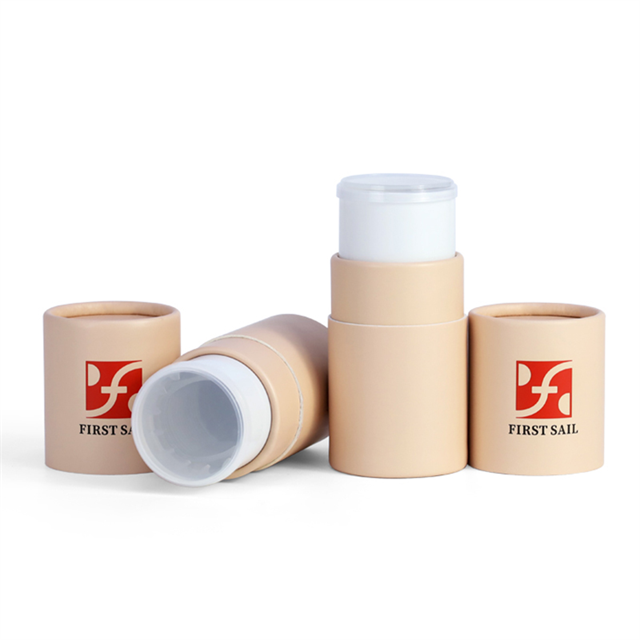
Consumer perception drives purchasing decisions heavily. Paper offers a premium, tactile feel. Eco-conscious demographics highly value this organic aesthetic. Paper tubes provide an excellent canvas for full-surface custom printing. You can utilize natural kraft paper, matte finishes, and elegant foil stamping. These design elements communicate brand authenticity. They tell a compelling sustainability story right on the retail shelf.
Plastic offers sleek, predictable familiarity. Consumers understand exactly how a plastic dial operates instinctively. Brands often associate plastic packaging alongside mass-market positioning. Clinical or sterile product lines also favor plastic aesthetics. It conveys hygienic reliability efficiently. However, it lacks the earthy, artisanal appeal found in paperboard alternatives.
Online community forums reveal authentic consumer pain points. Analyzing these complaints helps product developers refine their choices. Paper tube risks center around usability friction. Manual push-ups can become difficult to maneuver if the product melts. If a solid balm melts in a hot car and resets, it glues the inner disk to the walls. Additionally, paper caps can loosen over time due to daily cardboard wear. A major frustration occurs during dispensing. Users cannot easily "retract" pushed-out product back down the barrel.
Plastic tube risks center around structural brittleness and ecological guilt. Rigid plastics exhibit crack susceptibility when dropped on hard bathroom tiles. Furthermore, mixed-material components frustrate modern users. Environmentally aware consumers hate trying to dismantle a multi-part plastic tube for recycling. This frustration often leads to negative brand reviews online.
Brands often fall into the greenwashing trap accidentally. Verifiable eco-claims protect your brand reputation deeply. Forest Stewardship Council (FSC) certification remains the industry gold standard. FSC-certified paper sourcing guarantees responsible forestry practices. It ensures environmental compliance throughout your packaging supply chain.
End-of-life disposal presents another complex narrative. Paper packaging boasts true compostability and recyclability on paper. However, an important caveat exists here. Tubes heavily saturated by product oils face municipal rejection. Local paper recycling facilities often sort out oil-stained cardboard. They categorize it as contaminated waste. Therefore, home-compostability remains the more accurate marketing claim. You should educate consumers on proper backyard composting methods.
The truth about plastic recycling is often disappointing. Standard plastic lip balm or deodorant tubes face massive hurdles. They are notoriously difficult to recycle effectively. Their small physical size causes immediate problems inside material recovery facilities. They slip through the automated sorting screens easily. Furthermore, they contain mixed components. Recyclers cannot separate metal springs and different resin codes profitably.
Post-Consumer Recycled (PCR) plastics offer a popular alternative. PCR materials provide a viable middle ground for corporate sustainability goals. They reduce virgin fossil fuel consumption significantly. However, PCR does not solve the end-of-life landfill issue. A PCR tube still persists in the environment for centuries after its final disposal.
Budget constraints inevitably influence final packaging decisions. Plastic requires high upfront financial investments. Custom shapes demand expensive steel tooling and injection molds. These tooling costs can reach tens of thousands of dollars. However, plastic offers a very low per-unit cost at mass scale. Mega-brands leverage this volume to maximize profit margins.
In contrast, paper push up tubes require low to zero tooling costs. Manufacturers produce standard rolled diameters using existing mandrels. This eliminates prohibitive startup fees for indie brands. The trade-off appears in the unit price. Paper carries a marginally higher per-unit assembly cost. The production involves manual or semi-manual rolling and gluing processes.
Supply chain agility provides a massive competitive advantage. Paper tube production often allows for much faster prototyping phases. Standard sizes bypass the lengthy mold-making process entirely. Consequently, suppliers offer smaller MOQs for pilot launches. This flexibility drastically reduces inventory risk for unproven SKUs. You can test the market response before committing huge capital.
Plastic supply chains often move slower initially. Custom molds take months to engineer and perfect. Once operational, they churn out millions of units rapidly. However, the initial lead time requires careful product launch planning.
Selecting the optimal container requires brutal honesty about your product formula. Use the following framework to guide your final choice:
Choose Paper Push-Up If: Your product is a solid balm or wax. Your brand identity relies heavily upon zero-waste positioning. Your target audience happily tolerates slight manual friction in exchange for environmental benefits.
Choose Plastic (or PCR) If: Your formula contains high water content. You require an absolute airtight seal for volatile active ingredients. Your mass-market consumer demands precision retraction and zero usage friction.
Next Steps: Do not guess your compatibility. Request unprinted sizing samples immediately. Test standard capacities ranging from 0.3oz to 2oz. Initiate a 12-week accelerated stability test using your specific formula. Monitor weight loss, visual seepage, and mechanism functionality.
There is no universal "better" option in the packaging industry. There is only the most appropriate choice for your specific formulation chemistry and market positioning. You must align your packaging choice directly with your core brand values. Consumer expectations shift rapidly toward sustainable solutions, but functionality remains paramount.
Today, paper push up tubes have matured significantly in barrier technology. They are entirely viable for enterprise-level adoption across global markets. However, product managers must respect the physical boundaries of solid-state formulas. Conduct rigorous hot-pour testing early in your development cycle. Finalize your decision based on empirical compatibility data, not just aesthetic preferences. Proper planning ensures a successful, sustainable product launch.
A: High-quality paper push up tubes feature an oil-resistant inner lining and tight disk tolerances. However, formulations poured at excessively high temperatures may seep before setting. Testing pour temperatures is required.
A: No. Unlike threaded plastic twist-ups, paper push-ups use a one-way friction fit. Users are advised to push up only 1-2 millimeters at a time.
A: Standard sizes range from 0.3 oz (small lip balms) up to 2.5 oz or higher for deodorants and solid sunscreens. Custom dimensions are easily rolled without expensive molds.


