


Views: 0 Author: Site Editor Publish Time: 2026-11-02 Origin: Site


Transitioning to or optimizing tubular packaging requires balancing structural integrity against strict production budgets. We often see brands struggle when switching to round container formats. Incorrect specifications lead directly to crushed inventory and ruined products. They also compromise crucial moisture barriers and heavily inflate your overall shipping expenditures. You need a reliable method to prevent these costly errors before mass production begins. Proper planning protects both your product line and your operational efficiency. This article provides a precise, specification-driven framework for your packaging strategy. We will help you evaluate structural requirements and shortlist capable manufacturing vendors. You will learn how to successfully implement highly reliable containers tailored for commercial or industrial storage applications. By following these mechanical engineering guidelines, you can protect your goods completely. You will also create an elevated, premium unboxing experience for your end users without overspending.
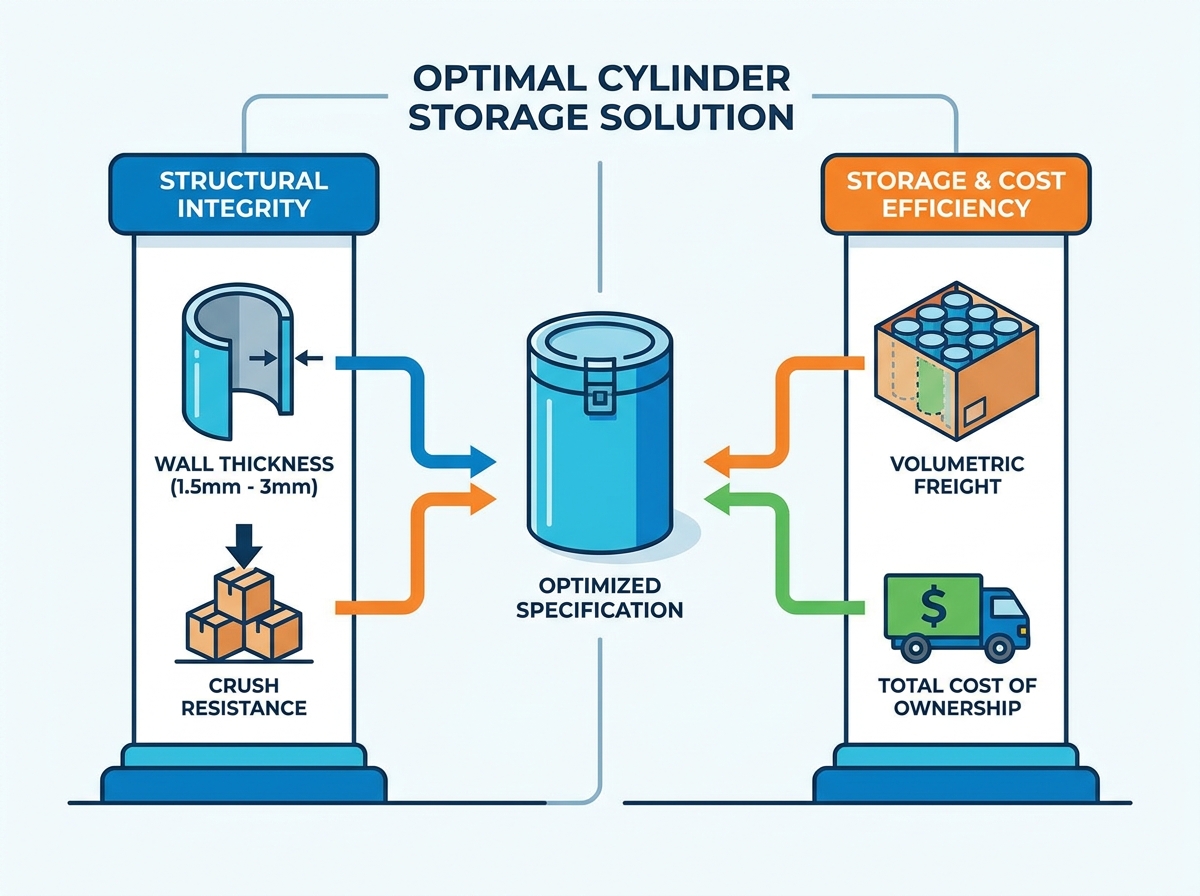
Wall thickness (typically 1.5mm to 3mm) and diameter-to-height ratios are the primary variables dictating vertical crush resistance.
Interior linings (e.g., aluminum foil, PE coating) are strict requirements for perishable, volatile, or moisture-sensitive goods.
Custom diameters require upfront tooling costs; aligning with manufacturer stock molds significantly accelerates ROI for initial rollouts.
Because cylinder boxes cannot ship flat, volumetric freight costs must be factored into the total cost of ownership.
Standard corrugated cubes routinely fail when protecting certain goods. Rolled documents quickly wrinkle in square corners. Fine powdered goods often leak through folded bottom flaps. Premium retail items lose their visual appeal inside standard rectangular cartons. Evaluating these failures helps frame our core business problem. We must adopt a container format perfectly tailored to specific product geometries. A rigid Cylinder box eliminates corner-crush risks entirely. The circular design distributes external pressure evenly across the entire outer wall. This geometric advantage prevents isolated stress points during heavy transit or aggressive handling.
You must establish clear success criteria before approving a design. A successful specification achieves 100 percent product containment during standard drop tests. We demand zero bottom-out failures under vertical warehouse stacking loads. The container must also guarantee automated filling line compatibility. Automated production lines require perfectly smooth internal walls. They also demand precise dimensional tolerances to prevent friction jams. Overlooking these tolerances causes massive delays on the assembly line.
You must also recognize the logistical implementation reality. A clear trade-off exists between aesthetic appeal and warehouse efficiency. You gain a premium unboxing experience and superior structural protection. However, you face an increased warehousing footprint. Non-collapsible containers require significantly more pallet space than flat-packed boxes. Empty tubes consume exactly as much space as filled tubes. You must calculate your available storage volume accurately before committing to this structural transition.
Core construction dictates the fundamental durability of your container. We primarily compare virgin kraft paperboard against recycled composite materials. Virgin kraft offers superior tensile strength. The longer, unbroken paper fibers provide immense resistance to tearing. It performs exceptionally well under high-stress conditions. Recycled composites meet strict environmental compliance requirements. They are highly sustainable and widely available. However, they sometimes lack extreme rigidity for heavy industrial applications. You must balance strength requirements against your corporate sustainability goals.
You must define exact wall thickness metrics for your project. Specify 1.5mm thickness for light retail goods like cosmetics or small apparel. Shift to 2.5mm or higher when securing dense powders or metal hardware. Thicker walls exponentially increase vertical rigidity. They prevent the container from bowing outward under heavy top-loads. Developing reliable Cylinder Box packaging requires precise material selection based entirely on payload weight. Adding just 0.5mm of thickness often doubles the crush resistance of the final tube.
Barrier layers protect volatile or perishable contents from environmental degradation. Specify food-grade aluminum foil linings to create complete oxygen and grease barriers. Use wax or polyethylene (PE) coatings to provide strong humidity resistance. You need these internal layers for long-term storage in fluctuating climates. Unlined paperboard absorbs moisture rapidly. This absorption weakens the glue layers and compromises the structural integrity of the tube over time.
Configuration Style | Security Level | User Access Frequency | Visual Profile |
|---|---|---|---|
Rolled Edge | Medium | High (Easy open) | Seamless, premium aesthetic |
Flat Flush | Medium to High | Moderate | Modern, minimal lines |
Metal/Plastic Plug | Very High | Low to Moderate | Industrial, highly secure |
Evaluating lid and base configurations ensures proper user functionality. Rolled edges provide a seamless visual profile. They hide raw paper edges entirely. Flat flush designs offer clean modern aesthetics but require precise friction fits. Metal or plastic plug closures deliver maximum security for heavy-duty storage. Select your closure style based on how frequently users access the internal product.
Dimensional tolerances govern the success of automated production lines. We must constantly account for +/- 1mm to 2mm internal variations. Paper winding naturally creates slight dimensional shifts during the gluing process. These essential tolerances prevent friction damage during automated insertion processes. If margins are too tight, robotic arms will crush the product during loading. A slightly looser fit always outperforms a dangerously tight fit in mass production scenarios.
Proportion mapping prevents disastrous retail displays. Extreme diameter-to-height ratios negatively impact the center of gravity. Tall, narrow tubes tip over easily on retail shelves. They frustrate retailers and often damage internal contents. Short, wide tubes remain highly stable across uneven surfaces. However, they consume massive amounts of valuable shelf footprint. You must balance height and width carefully to ensure retail viability and display stability.
Oversized formats demand unique structural reinforcements. Designing a sturdy Large cylinder box involves significant engineering hurdles. You might package industrial posters, bulk textiles, or heavy liquids. These massive containers require reinforced base adhesion techniques. Standard glue spots fail under heavy vertical pressure. Manufacturers must utilize highly constrained, thicker walls to prevent buckling under their own weight. We often specify a minimum 3mm wall thickness for oversized units to guarantee safety.
Volumetric efficiency presents a major logistical challenge. Calculate the dead-space loss carefully before finalizing shipping budgets. Packing round tubes into square master cartons creates roughly 21 percent dead space. You must optimize your pallet configurations to mitigate this mathematical loss. Clever nesting or staggered packing sometimes recovers wasted space. Always model your pallet dimensions before finalizing tube heights to maximize container capacity.
Establishing regulatory baselines protects your brand from costly recalls. We require a strict framework for verifying FDA-approved adhesives. You must ensure food-contact safe inner linings for consumable goods. Request official compliance certificates from every prospective supplier. Never assume baseline paperboard is food-safe without rigorous chemical testing. Industrial recycled paper often contains harmful trace contaminants. Manufacturers must prove their inner linings isolate these contaminants completely from the food payload.
Durability testing reveals structural flaws before mass production begins. We utilize several industry-standard evaluation methods. Evaluate Edge Crush Test (ECT) equivalents specifically adapted for round tubes. Standard flat corrugated ECT formulas do not directly translate. Circular geometry distributes stress entirely differently across the vertical axis. You must also conduct environmental chamber testing. Moisture rapidly degrades structural integrity and causes severe warping. We simulate high-humidity environments to test baseline adhesive strength over prolonged periods.
Transparently evaluate supplier sustainability claims to avoid greenwashing. Using eco-friendly Cylinder Box packaging elevates brand trust significantly among modern consumers. Follow a strict verification protocol before approving marketing language.
Verify FSC-certified paper sourcing through registered international certification numbers.
Request official safety data sheets confirming the use of authentic soy-based inks.
Test end-user recyclability by verifying the water-solubility of the structural adhesives.
Audit local recycling facility acceptance criteria for mixed composite materials.
These rigid checks ensure your packaging meets actual environmental standards. Do not rely solely on vendor marketing brochures. Independent verification is mandatory. False sustainability claims can permanently damage your corporate reputation. Always demand physical proof of chemical composition.
Financial analysis drives the tooling versus stock mold decision. Adopting a manufacturer’s existing inner-diameter mold saves capital. It typically eliminates $500 to $2000 in upfront tooling costs. Investing in a custom die offers precise branding flexibility. However, it slows your initial rollout considerably. We recommend matching standard mold diameters and customizing only the tube height. Height adjustments rarely require expensive new tooling modifications. This strategy accelerates market entry significantly.
Minimum Order Quantities impact unit pricing heavily. Most factories require 1,000 to 5,000 units per initial run. You should plan strategic phased rollouts. Order smaller batches initially to test market reception. Procurement teams must specify Cylinder box dimensions with absolute precision before scaling up to 50,000 units. Scaling too quickly with an untested prototype leads to massive inventory waste. Small test runs expose hidden manufacturing defects early.
You must establish a strict prototyping protocol. Request unprinted, physical structural samples immediately. We call these physical samples "white dummies." Conduct real-world fit and drop tests using actual heavy products. Never authorize full production runs without testing these dummies first. The theoretical dimensions often differ slightly from the physical paper behavior. A paper tube can shrink marginally as the adhesive cures over a week.
Supplier evaluation requires deep technical auditing. Focus entirely on their in-house tube-winding capabilities. Review their quality control protocols for adhesive curing times. High defect rates often stem from rushed curing processes. Ensure the vendor possesses advanced climate-controlled drying rooms. This prevents moisture from trapping inside the paper layers. Trapped moisture causes the paper layers to separate unpleasantly upon delivery.
We moved from defining rigid structural needs to successfully testing physical prototypes. Specifying these containers is a strict mechanical engineering decision. It is just as important as the visual branding design. Following a structured methodology ensures your packaging performs perfectly under stress. You must rely on precise mathematical tolerances to avoid production disasters.
Finalize your internal dimensional requirements before contacting any suppliers for estimates.
Define clear material constraints based strictly on product sensitivity and payload weight.
Generate a precise Request for Quote outlining all inner diameter and wall thickness metrics.
Request unprinted white dummies to conduct physical stress and drop testing immediately.
A: A heavy-duty container typically utilizes a wall thickness ranging from 2mm to 3mm. You should use this thickness when packaging dense materials like powders, hardware, or large glass bottles. This range provides exceptional vertical crush resistance. It prevents the side walls from bowing outward under heavy warehouse stacking loads.
A: No, rigid tubes cannot be flattened for shipping. This structural reality means you will always pay for volumetric weight. However, if the lids are separate from the bases, you can employ nesting strategies. Inserting slightly smaller tubes into larger ones helps optimize shipping space and reduces overall expenditures.
A: You must understand the difference between Inside Diameter (ID) and Outside Diameter (OD). The Inside Diameter is the critical metric for product fit and custom inserts. Always specify the ID when ordering. The OD merely dictates external master carton sizing and retail shelf space requirements.
A: Standard paperboard friction-fit lids remain the most cost-effective closure style. They require no specialized tooling and utilize the exact same materials as the tube body. Metal end-caps offer superior security and longevity for industrial applications, but they significantly increase per-unit manufacturing expenses.


